
Ditching the "Just-in-Time" Headache: How Real-Time Data Beats 2026 Material Inflation
- Oliver Clayton
- Feb 9
- 5 min read
If you're a contractor in 2026, you've already felt the squeeze. Material costs are up, lead times are unpredictable, and the "just-in-time" (JIT) approach that worked brilliantly for decades now feels like playing Russian roulette with your project margins.
The problem isn't JIT itself, it's that the operating conditions have fundamentally changed. Global tariffs, climate-related supply shocks, and persistent inflation mean that lean inventory strategies often leave contractors exposed. One delayed steel shipment or sudden cement price spike can derail an entire project timeline and budget.
The solution isn't to abandon efficiency. It's to build smarter systems that give you real-time visibility and control over your material pipeline. Here's how infrastructure contractors are adapting in 2026, and why real-time data is the difference between protecting your margins and watching them evaporate.
The Just-in-Time Trap in 2026
Just-in-time inventory management was designed for a stable world: predictable suppliers, consistent lead times, and gradual price changes. Order what you need, when you need it, and minimise holding costs. Simple.
But 2026 isn't that world.

Material price volatility has become the norm rather than the exception. Steel prices can swing 15-20% in a quarter. Timber, concrete, and specialist components face similar fluctuations driven by energy costs, transport tariffs, and regional supply constraints. When you're ordering materials just weeks before installation, you're essentially gambling that prices won't spike before delivery.
The bigger issue is lead time uncertainty. A supplier might quote you six weeks, but geopolitical events, border delays, or production issues can easily double that timeline. If you're running a tight JIT operation, a two-week delay doesn't just push back your schedule, it cascades through every subsequent trade and activity.
Traditional JIT also relies on manual tracking: spreadsheets, email chains, and phone calls to check stock levels and order status. By the time you realise there's a problem, you're already behind. There's no early warning system, no predictive insight, just reactive firefighting.
Why Real-Time Data Changes Everything
Real-time data isn't about replacing JIT, it's about making it resilient. When you have live visibility into material orders, stock levels, supplier performance, and price trends, you can make proactive decisions instead of reactive ones.
Modern systems eliminate the data lag that plagues spreadsheet-based workflows. Instead of updating a master file every Friday afternoon, you're seeing actual stock movements, delivery confirmations, and usage rates as they happen across all your sites and warehouses.
This visibility enables several critical capabilities:
Automated reorder triggers based on actual consumption rates rather than static forecasts. If Site A is burning through rebar faster than expected, the system flags it before you hit critical levels.
Supplier performance tracking that highlights which vendors consistently deliver on time and which ones create bottlenecks. This intelligence lets you shift orders to more reliable suppliers when lead times tighten.
Price trend analysis that shows you whether material costs are rising or falling, helping you time larger purchases strategically. If cement prices are trending down, you might delay a bulk order by two weeks and save thousands.
Predictive alerts when stock levels, delivery dates, or consumption patterns deviate from plan. You're not discovering problems during the weekly site meeting, you're getting flagged 48 hours earlier when there's still time to act.

This shift from delayed, manual data to instant, automated intelligence fundamentally changes your operating model. You're no longer managing by hindsight, you're managing by insight.
The "Just-in-Case" Strategy for 2026
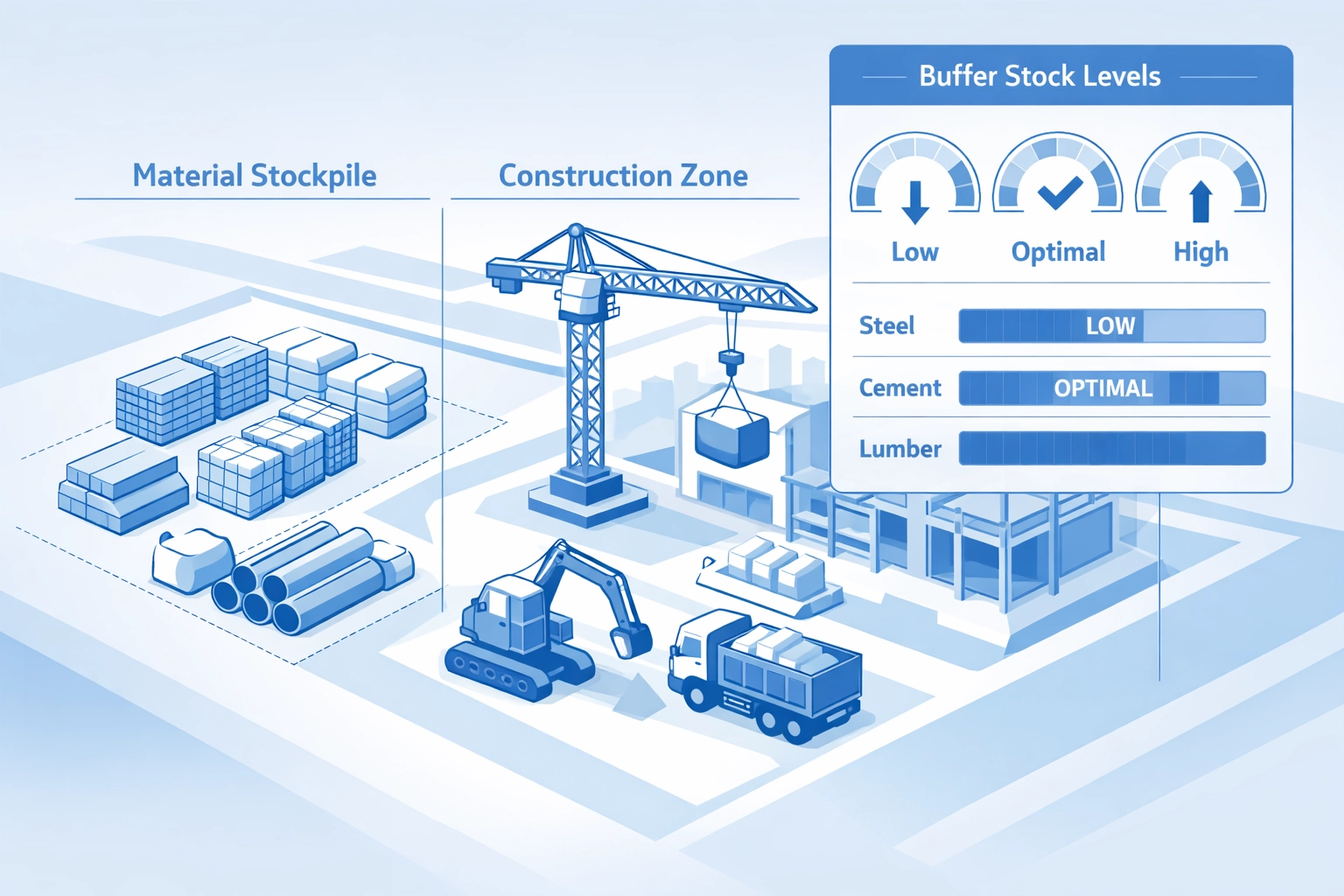
Smart contractors are evolving their approach from pure JIT to a hybrid "just-in-case" model that balances efficiency with resilience. This doesn't mean stockpiling everything (the old-fashioned buffer stock approach) but rather building strategic buffers for high-risk materials.
The key is identifying which materials warrant extra protection:
High-volatility items where prices swing significantly month-to-month
Long lead-time components that could delay critical path activities
Single-source materials where supplier failure would halt work
High-value items where price increases materially impact margins
For these materials, a just-in-case approach means ordering slightly ahead of immediate need and holding modest safety stock. Yes, there's a carrying cost: but it's minimal compared to the cost of project delays or emergency procurement at inflated prices.
Real-time data makes this strategy viable by showing you exactly how much buffer you actually need. Historical consumption data, lead time variability, and price trends inform your buffer calculations rather than guesswork.
You're not over-ordering blindly: you're ordering intelligently based on risk-adjusted demand forecasts.
How Real-Time Material Management Protects Margins
Let's get practical. Here's how real-time data systems help infrastructure contractors protect margins in the current environment:
Dynamic buffer management: The system automatically adjusts safety stock levels based on seasonal patterns and recent consumption trends. If you typically use 20% more aggregate during summer months, your reorder points shift accordingly without manual intervention.
Cost variance tracking: Every material delivery is logged against the original quote. If cement arrives at £15 per bag when you budgeted £12, you see the variance immediately: not at month-end when it's too late to recover costs through client variation orders.
Multi-site optimisation: Real-time visibility across all your projects lets you shift materials between sites to avoid duplicate orders. If Project A has surplus rebar and Project B is about to place an order, you can transfer internally and eliminate the purchase entirely.
Waste reduction: When site teams log usage in real-time, you can identify overconsumption or waste patterns quickly. Is Site B using twice as much concrete as Site C for similar work? That's a red flag worth investigating before it impacts profitability.
Supplier negotiation leverage: When you have data showing consistent order volumes and payment history, you can negotiate better pricing and preferential lead times. Suppliers value predictable customers: real-time systems help you become one.
Building Your Real-Time Material Workflow
Implementing this approach doesn't require ripping out existing systems or months of disruption. The path forward is straightforward:
Start with centralised visibility. Consolidate material orders, deliveries, and stock levels in a single system accessible to site teams, project managers, and procurement staff. Tools like IMS System provide this unified platform without requiring on-site servers or complex IT infrastructure.
Connect site teams to the data flow. Equip foremen and quantity surveyors with mobile access to log deliveries, usage, and stock checks in real-time. Offline capability is essential: many sites still have patchy connectivity, but data should sync automatically when signal returns.
Automate routine decisions. Configure reorder triggers, low-stock alerts, and delivery confirmations so procurement staff focus on exceptions rather than routine monitoring. The system handles the predictable; humans handle the strategic.
Review and refine regularly. Use historical data to continuously improve your buffer calculations, supplier selections, and order timing. What worked in Q1 might need adjustment by Q3 as conditions change.

The transition from reactive to proactive material management typically takes 4-6 weeks. The payback period is usually measured in months, not years: one avoided delay or captured price opportunity often covers the implementation cost.
The Competitive Advantage of Better Data
In 2026, infrastructure projects are won and lost on margins measured in single-digit percentages. Material costs represent 40-60% of total project spend for most civils contractors. Gaining even a 2-3% advantage through better purchasing, reduced waste, and delay avoidance translates directly to bottom-line profit.
Contractors still running JIT on spreadsheets are discovering: painfully: that manual processes can't keep pace with today's volatility. By the time they've updated the master file and circulated it for review, the market has already moved.
Real-time data creates a genuine competitive moat. You're making decisions with today's information while competitors are working from last week's snapshot. You're preventing problems that others are still discovering. You're protecting margins that others are losing to inflation and inefficiency.
The question isn't whether to adopt real-time material management: it's how quickly you can implement it before the next price spike or supply shock hits your active projects.
The just-in-time dream of perfect efficiency isn't dead: it's simply evolved. In 2026, efficiency means having the right information at the right time to make the right call. Real-time data is how you get there.
Ready to protect your margins with better material visibility? Explore how IMS System helps infrastructure contractors manage materials, reduce waste, and respond faster to supply chain challenges.
Comments